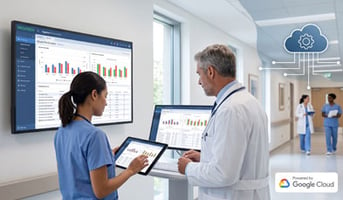

MEDITECH's recent recognition as a 2026 Google Cloud Partner of the Year (Business Applications:...
How MEDITECH's Evidence-Based Toolkits Drive Clinical Outcomes and Protect Revenue
In today's healthcare landscape, clinical excellence and financial sustainability go hand in hand. Unmanaged patient readmissions, preventable post-operative complications, and delayed interventions create severe friction for both clinical teams and operational budgets.
To bridge this gap, health systems are shifting away from manual, retrospective reporting. By leveraging MEDITECH's Expanse clinical surveillance toolkits, organisations can embed automated, point-of-care workflows directly into daily clinical practice — improving patient safety while protecting funding and reimbursable events.
Protecting Revenue, Funding, and Reimbursable Events
Preventable readmissions rarely generate new funding. Instead, they consume valuable bed capacity, distort average length-of-stay (LoS) metrics, and strain operational budgets by forcing hospitals to deliver duplicate care for a single illness episode.
The financial consequences of preventable readmissions vary by funding model and geography:
- United Kingdom: Under the NHS National Tariff Payment System (NTPS) — which replaced Payment by Results — readmissions within 30 days of elective procedures are generally not separately reimbursed, leaving trusts to absorb the cost of that secondary episode.
- Australia: Under Activity-Based Funding (ABF), unplanned readmissions within a defined window can be excluded from the funded episode count, directly reducing National Weighted Activity Unit (NWAU) income.
Across all models, the principle is the same: when a patient returns due to a preventable oversight, the health system absorbs the cost.
The Universal Operational Toolkit Impact
By deploying MEDITECH's customisable Surveillance watchlists and clinical monitoring tools, care teams gain real-time visibility into readmission risk factors, tracking live data such as lab values and medication regimens. This proactive monitoring allows clinicians to identify deteriorating patients and address potential complications well before discharge — keeping readmission rates low and protecting hospital funding.
Lowering Direct Treatment Costs Through Early Detection
The clinical progression of an unmanaged condition follows a steep cost curve — the later the intervention, the higher the financial and clinical burden. MEDITECH's clinical surveillance tools aim to flatten this curve by shifting care from a reactive state to a proactive one.
High-Value Clinical Toolkits in Action
-
Automated Sepsis Management
Sepsis is globally recognised as one of the most resource-intensive conditions to treat. In South Africa, sepsis poses a severe, multi-faceted public health burden driven heavily by HIV and tuberculosis, striking a significantly younger population than in high-income nations. Presenting in 13% to 14% of adult ICU admissions and driving up to 43% mortality in acute emergency settings, the condition also accounts for 11% of direct maternal deaths and causes mortality rates as high as 40% in vulnerable neonates and surgical patients.
MEDITECH's embedded sepsis algorithms screen live patient data against validated early warning criteria in real time. Catching sepsis early enables low-cost ward interventions — such as timely intravenous fluid resuscitation and empiric antibiotics (consistent with the Surviving Sepsis Campaign Sepsis Bundles, including the 3-hour and Hour-1 frameworks) — preventing complex, high-cost ICU admissions and reducing overall mortality.
-
Antimicrobial Stewardship (AMS)
Antimicrobial resistance (AMR) and the escalating cost of broad-spectrum antibiotics present both a clinical threat and a financial burden. At least 700,000 deaths worldwide already result from drug-resistant infections each year. Projections warn this could rise to 10 million deaths annually by 2050 if left unchecked — a figure cited by both the O'Neill Review on AMR (2016) and subsequently by the World Health Organization.
Centralised surveillance watchlists within the MEDITECH Expanse platform empower clinical pharmacists to monitor antibiotic therapy continuously across the inpatient population. This tool-driven approach facilitates a rapid, safe transition from expensive intravenous broad-spectrum drugs to targeted, lower-cost oral therapies as soon as a patient clinically stabilises — directly lowering pharmacy costs and reducing overall treatment expenses per patient episode.
-
Deteriorating Patient / Early Warning Scoring
For patients at risk of unexpected deterioration, delayed recognition is a primary driver of preventable ICU admissions and mortality. MEDITECH's deteriorating patient toolkits support continuous automated scoring using internationally recognised tools such as NEWS2 (National Early Warning Score 2), with configurable alert thresholds and escalation pathways. Automated triggering of rapid response or medical emergency team (MET) calls reduces the time between deterioration and intervention — a critical factor in outcomes.
-
Venous Thromboembolism (VTE) Prophylaxis
Hospital-acquired VTE — including deep vein thrombosis (DVT) and pulmonary embolism (PE) — represents a significant source of avoidable clinical and financial cost. MEDITECH's VTE toolkit embeds validated risk assessment tools directly into admission workflows: the Padua Prediction Score for medical (non-surgical) patients and the Caprini Risk Assessment Model for surgical patients. This prompts prophylaxis ordering, documents contraindications, and supports regulatory reporting — reducing both clinical risk and the financial exposure associated with a preventable VTE event.
-
Glycaemic Management
Poorly controlled blood glucose in hospital inpatients — whether in the context of known diabetes or stress hyperglycemia — is associated with increased infection rates, prolonged length of stay, and higher mortality. MEDITECH's glycaemic surveillance tools provide real-time monitoring of glucose trends across the ward, alerting nurses and pharmacists to patients outside target range and supporting safer insulin protocol management.
Driving Clinical and Financial Sustainability
By embedding evidence-based guidance directly into clinical workflows, MEDITECH's Expanse clinical surveillance toolkits empower care teams to make safer, faster, and more cost-effective decisions. The impact compounds across the organisation: each prevented ICU admission, avoidable readmission, or AMR-related complication represents both a clinical win and a protected revenue or funding line.
Shifting from reactive care to real-time clinical surveillance not only elevates patient safety and outcomes but also secures the long-term financial health of the organisation — turning the EHR from a documentation system into an active participant in clinical governance.